Away At Home : Morocco
September 2026 The Architecture of Nostalgia: How to Make a Home Abroad Feel Like a Moroccan Sanctuary
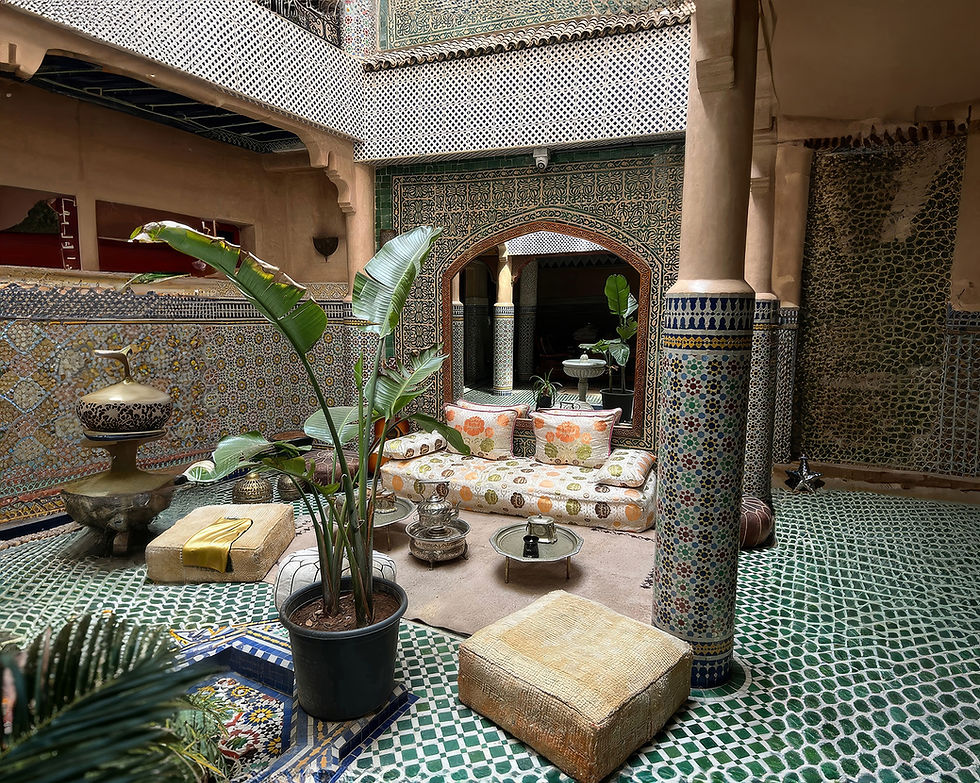
When moving away from Morocco, the absence of the homeland hits in distinct sensory waves. The mind misses the chalky, sun-baked texture of riad walls, the geometric perfection of zellige tiles underfoot, and the specific way afternoon light filters through a hand-carved copper lantern. For the global diaspora, home is not just a physical coordinate; it is a dense sensory landscape built on centuries of craftsmanship and radical hospitality.
Translating this heritage into an apartment or a suburban house abroad is not about creating a literal replica of a bustling Marrakech market square. It is about strategic storytelling. As Marrakech based Moroccan interior designer Hamza Rachad notes, “A space should feel like a story you can walk into.”
By utilizing the core principles of Moroccan design, diaspora members can seamlessly weave their heritage narrative into any contemporary living space abroad.
1. Grounding the Space with Textures over Saturated Colours
A common misconception is that a Moroccan inspired room requires painting the walls in loud, highly saturated jewel tones. However, traditional riads frequently rely on a remarkably neutral foundation, sandy beiges, chalky whites, and soft terracottas that mirror the natural landscape. The true warmth of the room is achieved through depth of texture.
Instead of standard, flat latex paint, tactile depth can be introduced to walls and floors:
The Tadelakt Illusion: Traditional Moroccan tadelakt is a waterproof, polished lime plaster that gives surfaces an organic, marble-like sheen. This look can be recreated abroad by applying a high-quality limewash or micro-cement finish to a standard accent wall.
Layered Rugs as Flooring Artwork: If a rental property is bound by cold, generic floorboards or synthetic carpets, the room can be instantly anchored with an authentic, hand woven Berber rug, such as a plush Beni Ourain or a flat-woven Kilim. Layering these textiles creates immediate psychological comfort.
2. Designing for Conviviality: The Art of the Low Profile
While some cultures push furniture against walls or centers it around a television screen, Moroccan interior architecture explicitly configures spaces to foster human connection and open hospitality.
To bring this welcoming spirit into a home abroad, furniture layouts can be consciously reconfigured:
Low Profile Seating: Swapping out towering, formal couches for deep, low-profile modular sofas, traditional floor cushions, or leather poufs lowers the seating height. This adjustment immediately establishes a relaxed, conversational, and intimate mood.
The Multi-Functional Centerpiece: Instead of a massive, immovable coffee table, utilizing a cluster of hand-carved wooden side tables or traditional geometric metal trays provides flexibility. Surfaces can be easily shifted around to serve mint tea and pastries whenever guests drop by unexpectedly.
3. Letting the Shadows Tell the Story
Lighting is arguably the most critical element when translating the Moroccan soul into a foreign interior. Traditional lighting does not just illuminate a space; it completely transforms the environment through pattern and shadow.
As celebrated Moroccan interior designer Naima Abidin emphasizes in her design ethos, “Light is life and for us it is very important, and so we let it into our homes.” Abidin highlights that illuminating an authentic Moroccan space requires mixing textures, recommending a curated blend of "Arabic copper ceramic lamps," "wrought iron lanterns with coloured glass," and "carved wooden lamps."
Hanging pierced brass or copper pendant lanterns in areas meant for unwinding, such as bedrooms or reading nooks, completely alters a room's evening atmosphere. When the sun goes down, the intricate, hand chiseled geometries cast mesmerizing, shifting shadows across plain modern ceilings, creating an instant feeling of mystical comfort far away from home.
4. Celebrating Detail and Fine Craftsmanship
Traditional Moroccan design masterfully balances bold spatial layouts with meticulous attention to hand carved detail. One does not need an entire arched courtyard or structural pillars to honor this legacy; the focus should remain on high-quality statement details.
Integrating an intricately carved cedarwood mirror frame, a beautifully distressed bone inlay side chest, or subtle geometric motifs woven into throw cushions provides functional artistry. These deliberate touches keep the home grounded in its roots every single day.
Step Into the Forum
What is the one item from your home country that immediately makes your living space abroad feel safe and comforting? Whether it is a specific textile, a piece of pottery, or a framed image, every story matters. Head over to the [Community Interior Design Hub] to share photos of your home setups, ask for styling advice, or discover local diaspora-led artisan makers. Let’s inspire one another.
Comments